

The short answer
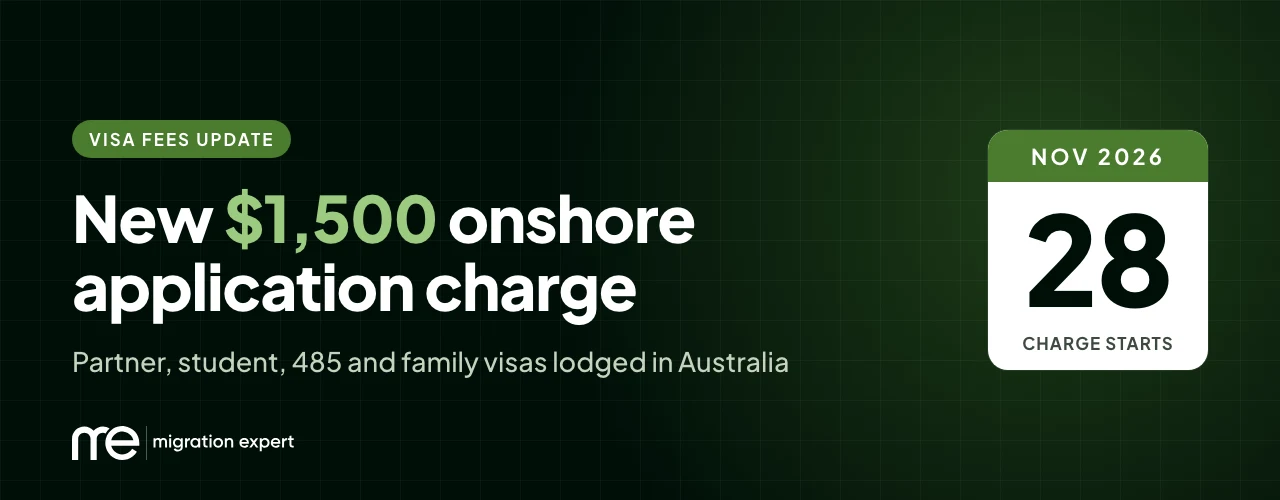
From 28 November 2026, many visa applications made while you are in Australia cost $1,500 more per person. The new fee is called the Onshore Application Charge. It applies to partner, student, student guardian, Temporary Graduate (485), child, parent and other family visas.
The charge is paid when you lodge, on top of the normal visa application charge. Every person in the application pays it, so a couple pays $3,000 extra and a family of three pays $4,500 extra.
The change came with almost no warning. The regulations were made on 26 November, registered on 27 November and started on 28 November. Applications lodged before 28 November are not affected.


- Employer-sponsored and skilled visas are not covered. The 482, 186, 494, 189, 190 and 491 visas are not on the list.
- Some people are exempt. These include eligible Pacific Island and Timor-Leste citizens, and ASEAN citizens applying for a student visa.
- The 485 visa is the hardest to avoid. You must be in Australia to apply for it, so almost every 485 applicant now pays the charge.
Which visas are covered
The regulations name nine visa classes. If your visa is not in this table, the Onshore Application Charge does not apply to it.
| Visa class | Visas it covers |
|---|---|
| Partner (Residence) (Class BS) | Partner visa (subclasses 820 and 801) |
| Student (Temporary) (Class TU) | Student visa (subclass 500) and Student Guardian visa (subclass 590) |
| Skilled (Provisional) (Class VC) | Temporary Graduate visa (subclass 485) |
| Child (Residence) (Class BT) | Child visa (subclass 802) and Orphan Relative visa (subclass 837) |
| Extended Eligibility (Temporary) (Class TK) | Dependent Child visa (subclass 445) |
| Aged Parent (Residence) (Class BP) | Aged Parent visa (subclass 804) |
| Contributory Aged Parent (Residence) (Class DG) | Contributory Aged Parent visa (subclass 864) |
| Contributory Aged Parent (Temporary) (Class UU) | Contributory Aged Parent (Temporary) visa (subclass 884) |
| Other Family (Residence) (Class BU) | Remaining Relative (835), Carer (836) and Aged Dependent Relative (838) visas |
Visas that are applied for from outside Australia sit in different visa classes and are not on the list. That includes the offshore Partner visa (subclasses 309 and 100) and the offshore parent visas.
How the charge works
- It is $1,500 per person. Home Affairs describes it as "a per-person charge, not a single charge per application".
- You pay it when you lodge. It is part of the first instalment of the visa application charge. There is no separate form.
- It depends on where you are when you apply. You pay it if you are in Australia when the application is made.
- Family members overseas can still pay it. In a combined application, a family member pays the charge if either they or the main applicant are in Australia when the application is made.
- It applies by lodgement date. Only applications made on or after 28 November 2026 are caught.
What it does to the price
These examples use the "from" prices on the Home Affairs visa pages for one applicant. Family members cost more, and each one also pays the $1,500.
| Visa (one applicant) | Before 28 November 2026 | From 28 November 2026 |
|---|---|---|
| Student visa (subclass 500), applied for in Australia | From $2,500 | From $4,000 |
| Temporary Graduate visa (subclass 485) | From $5,750 | From $7,250 |
| Any other visa in the table above | The normal charge | The normal charge plus $1,500 |
For your own figure, use the Visa Pricing Estimator on the Home Affairs website. Set the lodgement date to 28 November 2026 or later and add every person in your application.
Who does not pay it
The explanatory statement to the regulations lists four groups that are exempt:
- Pacific Island and Timor-Leste citizens who hold a valid passport from one of the listed countries, for certain visas. Home Affairs confirms this for the 485 and student visas.
- ASEAN citizens applying for a Student visa (subclass 500). ASEAN is the Association of Southeast Asian Nations.
- Student visa applicants enrolled in an ELICOS or non-award course. ELICOS courses are English language courses for overseas students.
- People who apply from outside Australia, for visas that allow it.
Exemptions depend on your passport, your visa and your course. Check the estimator for your own case before you lodge.
What it means for each visa
Temporary Graduate visa (subclass 485)
You must be in Australia to apply for a 485 visa, so there is no offshore option for the main applicant. Home Affairs says the charge now applies to all 485 applications unless you are exempt.
Family members pay it too, wherever they are. Home Affairs says the charge "applies regardless of whether your family members are inside or outside Australia when they apply". If they lodge from overseas, the Department may contact you to arrange payment so their applications are valid.
Partner visa (subclasses 820 and 801)
The onshore partner visa was already one of the most expensive visas Australia offers. It now costs $1,500 more for the main applicant and $1,500 more for each child or other family member in the application.
The offshore Partner visa (subclasses 309 and 100) is not covered. Please don't choose it only to save $1,500. Applying offshore means you don't get a bridging visa, and it changes where you can live and work while you wait. Get advice before you decide.
Student and Student Guardian visas (subclasses 500 and 590)
The charge applies to student visa applications made in Australia. Home Affairs says it applies "if you meet an exemption to apply for a Student visa in Australia". If you apply for your student visa from overseas, you don't pay it.
Citizens of ASEAN countries, Pacific Island countries and Timor-Leste don't pay it on a student visa. Nor do applicants for ELICOS or non-award courses.
Parent, child and other family visas
The charge is added to the first instalment only. Parent visas also have a second instalment before the visa is granted, and that has not changed.
Employer-sponsored and skilled visas
Nothing changes for the 482 visa, the 186 and 494 visas, or the 189, 190 and 491 skilled visas. They are not on the list, even when you apply from inside Australia.
One point for graduates: the Skilled (Provisional) class in the regulations is the class that holds the 485 visa. It is not the 491 visa.
Why the Government introduced it
The charge is a 2026–27 Budget measure. The explanatory statement says the extra revenue supports the Government's migration reforms and puts downward pressure on net overseas migration. It also says the charge is meant to encourage people to lodge certain applications from outside Australia where that is appropriate.
What to do now
- Redo your budget. Add $1,500 for every person in the application, including children.
- Check whether you are exempt. Your passport or your course may mean you pay nothing extra.
- Think about who is included. Each family member adds $1,500, but leaving someone out can cause bigger problems later.
- Don't let your visa run out. If your current visa expires soon, lodging on time matters more than the extra charge.
- Get advice before switching to an offshore application. It can affect your eligibility, your bridging visa and your right to stay.
If you are not sure how the charge applies to you, book a consultation and we will work out your costs and options with you.
Frequently asked questions
What is the Onshore Application Charge?
It is a new $1,500 component of the visa application charge. You pay it with the first instalment if you apply for one of the listed visas while you are in Australia.
Is it $1,500 per application or per person?
Per person. A main applicant with a partner and one child pays $4,500 in Onshore Application Charges.
I lodged before 28 November 2026. Do I have to pay?
No. The charge only applies to applications made on or after 28 November 2026.
Does it apply to the 482, 186 or 494 visa?
No. Employer-sponsored visas are not on the list. Nor are the 189, 190 and 491 skilled visas or visitor visas.
My family member is overseas. Do they still pay?
Yes, if they are part of a combined application and the main applicant is in Australia when it is made.
Can I avoid it by applying from outside Australia?
Only for visas that can be applied for offshore, and only if everyone in the application is outside Australia. The 485 main applicant can't do this. Applying offshore has its own costs and risks, so get advice first.
Sources
- Federal Register of Legislation, Migration Amendment (Onshore Application Charge and Other Measures) Regulations 2026 and its explanatory statement (registered 27 November 2026)
- Department of Home Affairs, Fees and charges for visas
- Department of Home Affairs, Temporary Graduate visa (subclass 485) and Student visa (subclass 500) pages, as updated on 28 November 2026
Remember:
This post is for general informational purposes only and is not a substitute for professional immigration advice. Given the uniqueness of every case, engaging with a registered migration agent is highly recommended for bespoke guidance and to navigate the specific details of your situation effectively. Book a visa consultation with a Registered Migration Agent
Subscribe to our newsletter
Sign up to our weekly newsletter to get the latest news about all things visas & immigration.